Claude Certification: Who Should Skip It in 2026?
Not every role benefits from the CCA-F. We assess the exam's value by job function, experience level, and team context to help you decide whether to register.
By Solomon Udoh · AI Architect & Certification Lead
You have a browser tab open on the registration page. The fee is $125, the time commitment is somewhere between 20 and 30 hours, and the credential is three months old, which means nobody on your team can tell you whether it matters yet. So you do what every architect does with an unpriced asset: you search "is the Anthropic Claude certification worth it" and find a SERP full of prep-site hot takes quoting salary figures that no survey has had time to produce.
This post is the analysis we wished existed when the CCA-F launched in March. Specifically: what the Claude Certified Architect, Foundations (CCA-F) actually costs in money and hours, what the $100 million partner economy behind it means for the signal it sends, a verdict by role (consultant, in-house architect, IC engineer), and an honest section on who should skip it. We build a certification prep platform, so we have an obvious interest in you sitting the exam. We have a stronger interest in being the one source on this query that does not invent numbers. Every figure below traces to a primary source or to our own learner data, and we will tell you which is which.
The short version, for the impatient: worth it for consultants and client-facing architects right now, worth it as a forcing function for IC engineers, not worth it if you have never shipped anything with Claude. The longer version is where the actual decision lives.
The certification, priced out
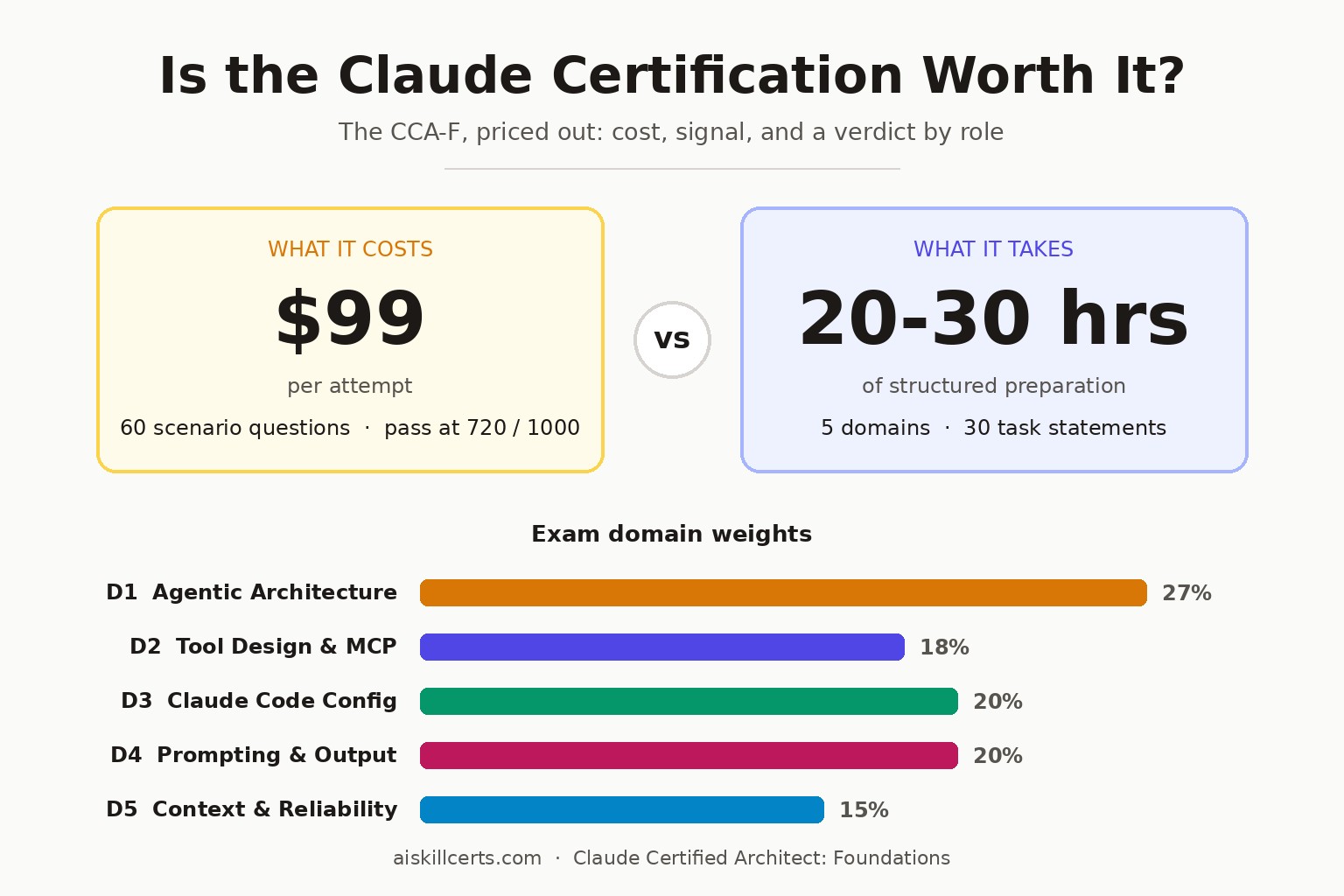
The direct cost is $125 per attempt, and the real cost is your prep time. Per Anthropic's official Certification Exam Guide and the exam registration page, the CCA-F is 60 scenario-based multiple-choice questions across five domains and 30 task statements, scored on a 100 to 1000 scale with a passing mark of 720. Anthropic does not publish the raw-to-scaled conversion, and the guide notes that scaled scoring varies by exam form, but on a linear read of the scale (the model our practice exams use), 720 lands at roughly 41 to 42 of 60 questions: about a 69% bar, which is forgiving by professional-certification standards but less forgiving than it sounds, because every question is a production scenario with three plausible distractors rather than a definition recall.
Anthropic positions it, in the words of the Claude Partner Network announcement, as "a technical exam for solution architects building production applications with Claude". Take the phrasing seriously. This is not an AI-literacy certificate of the kind Anthropic Academy hands out for completing its self-paced courses; it is a proctored exam (delivered online-proctored or at a test center via Anthropic's exam portal) that assumes you have already built things and asks whether you built them for defensible reasons.
In our internal data, candidates with real hands-on Claude experience need 20 to 30 hours of structured preparation to reach a consistent 720-equivalent on practice material. At a contractor's notional $150 per hour, that puts the true cost of the credential somewhere between $3,100 and $4,600, of which the exam fee is rounding error. The arithmetic is dull; the conclusion is not: the question "is the CCA-F worth $125" is the wrong question. The right question is whether it is worth a working week of your attention, and that depends almost entirely on who will be reading your CV.
Why this credential exists, and who is paying for it
The CCA-F did not appear in a vacuum; it launched on 12 March 2026 as one plank of a $100 million programme. Anthropic's Claude Partner Network announcement commits that money to partner training, technical support, and joint market development, and names the certification as the network's first technical credential. The same announcement puts hard numbers on the demand side: Accenture is training 30,000 of its professionals on Claude, and Cognizant is supporting an organisation of roughly 350,000 associates.
The Cognizant figure deserves a second look, because it predates the certification entirely. In November 2025, Cognizant announced it would make Claude available to up to 350,000 employees, with its own press release specifying Claude Code for "coding tasks, testing, documentation and DevOps workflows" across engineering and delivery teams. When a system integrator points a six-figure workforce at one vendor's tooling, it creates an internal staffing problem: who is allowed to lead the Claude engagements? Certifications are how consultancies have answered that question since the AWS partner economy industrialised it a decade ago.
The early adoption curve says the consultancies have noticed. By Anthropic's Services Track announcement on 3 June 2026, more than 40,000 firms had applied to join the partner network and more than 10,000 consultants had already earned a Claude certification, in under twelve weeks. The same announcement confirms that certifications belong to individuals, not firms, and that tiered partners get discounted rates on their first exam attempt. Read those three facts together and the design is plain: Anthropic is building a certified-headcount market, the consultancies are the anchor buyers, and the credential is the unit of account.
What a $125 exam can and cannot signal
A $125 exam cannot signal scarcity of money, so its value rests entirely on scarcity of demonstrated judgment, and right now that scarcity is real. Three months post-launch, more than 10,000 people hold a Claude certification against a partner ecosystem of 40,000-plus applicant firms. Compare that with the AWS credential economy, where the architect certification is table stakes precisely because millions hold one. Early certifications behave like early equity: most of the differentiation value accrues to people who move before the credential is commoditised. The trade-off is real, though: the same recency cuts the other way, because a credential nobody has heard of yet needs a sentence of explanation in every interview where it appears.
On salary, we will say plainly what the prep-site SERP will not: there is no credible CCA-F salary data, and anyone quoting a "Claude certification salary" in June 2026 is making it up. The certification is twelve weeks old; no compensation survey has had a collection cycle in which to segment on it. The honest adjacent evidence is Lightcast's Beyond the Buzz report (July 2025), built on over 1.3 billion job postings, which found that postings requiring AI skills carry a 28% salary premium, nearly $18,000 a year, and that 51% of those postings now sit outside IT occupations. That is a premium for demonstrable AI skills, not for any specific certificate. The defensible claim is therefore narrower than the prep sites want it to be: the skills the CCA-F examines are the ones carrying the premium, and the certificate is a cheap, verifiable proxy for them.
Whether an Anthropic certification is worth it, in other words, depends on how much your market relies on proxies. Consultancies staff engagements on proxies; that is what a partner tier is. In-house hiring relies on them at the screening stage and discards them at the system-design interview. Your role determines which of those markets you are selling into, which is why a single verdict is the wrong shape for this question.
The verdict by role
The practical heuristic: the closer your work sits to a billable engagement, the higher the CCA-F's return; the closer it sits to a single codebase you already own, the more the value shifts from signal to forcing function.
| Role | Signal value | Skill-gap value | Verdict |
|---|---|---|---|
| Consultant / SI architect | High: partner tiers staff on certified headcount | Medium | Sit it now |
| In-house solution architect | Medium: screening-stage proxy, interview-stage shrug | High | Sit it this year |
| IC engineer shipping with Claude | Low today, rising with partner-network growth | High | Worth it, eyes open |
| Engineering manager / CTO | Low for self, high as a team rubric | Medium | Certify the team, not just yourself |
| No production Claude experience | Near zero: the exam assumes context you lack | Low (wrong sequence) | Skip for now |
Three of those rows deserve expansion.
- Consultants and SI architects. This is the unambiguous case. Your employer is one of the 40,000 applicant firms or wants to be; certified individuals are what partner tiers count; first attempts are discounted for tiered partners; and Accenture alone is training 30,000 people who will shortly be your internal competition for Claude engagements. The credential's value here is not hypothetical, it is procedural: it is the box your staffing system checks.
- In-house solution architects. The CCA-F's value to you is split between signal and substance. As signal it gets you past screens and gives a vendor-selection paper trail ("our architects are certified on the platform we chose"). As substance, the syllabus is a usefully opinionated map of production-Claude judgment: the kind of judgment that, in our experience grading several thousand learner sessions, most self-taught builders have in patches rather than end to end.
- IC engineers. Be honest with yourself about which value you are buying. The certificate will not move your pay this year; no data says otherwise. What it buys is a forcing function: a fixed syllabus, a calendar date, and an external bar that converts "I should really understand context management properly" from an intention into 25 scheduled hours. It feels like overhead in week one. It pays out the first time you debug a production incident from first principles instead of from folklore.
Who should skip it
If you have never put Claude into anything resembling production, skip the CCA-F for now: you would be memorising answers to questions you have not yet felt. The exam's scenario format is unusually hostile to pure book-learning, because the distractors are exactly the plausible-but-wrong choices that inexperienced builders make. Sit the exam after your first real project and the questions read as war stories; sit it before and they read as trivia with four believable answers.
Skip it, too, if your organisation is committed to a different stack. The AI-skills premium Lightcast measured attaches to skills, not certificates, and most of the CCA-F syllabus (agent loops, tool design, context budgets, evaluation discipline) transfers across providers. But the certificate itself is vendor-scoped, and a vendor-scoped credential for a vendor you do not use is a conversation piece, not an asset. Generalists optimising for breadth get a better return from shipping one more real system than from any exam.
And skip it this quarter, though not forever, if you are senior enough that your reputation already does the certificate's job. A principal architect with three production agent platforms on their record gains little screening value from a foundations-level credential. The calculus changes if Anthropic ships the additional architect and developer certifications it has said are coming later in 2026: foundations certificates have a way of becoming prerequisites.
What the exam actually rewards
Here is the part that genuinely surprised us when we mapped the syllabus into our knowledge graph: the CCA-F is a judgment exam wearing a multiple-choice costume, and that is the strongest argument for its value as study, independent of the certificate. The intellectual spine is Anthropic's own Building Effective Agents (December 2024), which draws the line between workflows, where "LLMs and tools are orchestrated through predefined code paths", and agents, where the model directs its own process. A remarkable share of the exam is that one distinction, restaged in sixty different production scenarios. If you can argue when a model should drive the decision and when configuration should, you are most of the way to passing Domain 1, which at 27% is the heaviest of the five.
The remaining domains follow the same pattern: each tests one load-bearing judgment rather than a catalogue of facts. Domain 2 (18%) turns on the unglamorous truth that tool descriptions are the selection mechanism, so a vague description is an architecture bug, not a documentation gap. Domain 3 (20%) keeps probing whether you know which guidance belongs in CLAUDE.md and which belongs in a skill. Domain 4 (20%) is structured-output discipline, including designing schemas so the model cannot fabricate what it does not know. Domain 5 (15%) is reliability under long context, anchored by failure modes like the lost-in-the-middle effect that most builders discover only after an outage.
The recurring exam reflex worth naming, because it decides borderline questions: when stakes are high, the exam rewards deterministic enforcement over prompted good intentions, a distinction we cover at length in prompt-based vs programmatic enforcement. Candidates lose marks not for ignorance but for optimism: picking the answer where the model is politely asked to behave, when the scenario was begging for a hook, a schema, or a hard prerequisite. If you cannot point at the mechanism that enforces a constraint, you have not enforced it; you have hoped. The exam grades hope harshly, and so does production.
Is the Anthropic Claude certification worth it?
For most working architects and consultants in June 2026, yes, with a clock attached. The asymmetric case is the consultant: $125 and a working week of prep against a $100 million partner programme that counts certified individuals as its unit of staffing, while the credential is still scarce, with more than 10,000 holders to date. The moderate case is the in-house architect or IC engineer, for whom the CCA-F's value is two-thirds curriculum and one-third signal: a forcing function that turns scattered production instincts into an end-to-end judgment framework, with a verifiable line on the CV as the by-product. The negative case is real too: no production experience, a non-Claude stack, or a reputation that already outranks a foundations credential, and your week is better spent shipping.
Our own verdict, after building a prep platform around its syllabus: the exam is better than it needed to be. Anthropic could have shipped a recall quiz and the partner economy would have absorbed it anyway; instead the CCA-F examines the exact judgments that separate systems that survive contact with production from systems that demo well. That is what makes the CCA-F certification value question easier than most "is the cert worth it" questions: even in the worst case, where the credential never moves a salary number, the preparation leaves you a measurably better Claude architect. Certifications rarely offer that floor.
FAQ
How much does the Claude Certified Architect exam cost?
The list price is $125 per attempt. Tiered Claude Partner Network firms receive discounted rates on their employees' first attempts, per Anthropic's Services Track announcement of 3 June 2026, so check your firm's partner status before paying retail. Budget the real cost as 20 to 30 hours of preparation on top of the fee.
Does the Claude certification increase your salary?
No direct data exists yet: the credential launched on 12 March 2026, too recently for any compensation survey to measure. The nearest credible evidence is Lightcast's finding that job postings requiring AI skills pay a 28% premium (nearly $18,000 a year). The CCA-F tests those skills; treat any site quoting a specific "Claude certification salary" as fiction.
How hard is the CCA-F exam?
You need 720 on a 100 to 1000 scale, roughly 41 to 42 of 60 questions on a linear read of the scale; Anthropic does not publish the exact conversion. Every question is scenario-based with three plausible distractors, so it punishes book-only preparation. In our learner data, Domain 1 (Agentic Architecture, 27%) and the evaluation-flavoured task statements are where most candidates lose marks; our domain-by-domain difficulty breakdown scores all 30 task statements.
Is the Anthropic Claude certification worth it for beginners?
Not yet. The exam assumes production context: it is pitched at "solution architects building production applications with Claude", and its distractors are precisely the mistakes beginners have not yet made and learned from. Build one real project first, even a small one, then certify. The sequence matters more than the speed.
How long does it take to prepare for the Claude certification?
With six months or so of hands-on Claude experience, plan for 20 to 30 hours of structured preparation across the five domains. Without that experience, no honest number exists, because you would be acquiring the experience and the exam readiness at the same time. Weight your hours by the domain weights: 27% and 20% domains first.
Will there be more Anthropic certifications after the CCA-F?
There already are. The Claude Partner Network now spans four tracks: the Associate Foundations (CCAO-F, $99), the Developer Foundations (CCDV-F, $125), the Architect Foundations (CCAR-F, $125, the exam this post is about), and the Architect Professional (CCAR-P, $175). Anthropic has said further tracks will follow later in 2026, with network partners getting priority access. That roadmap is one argument for sitting a foundations exam early: launch-wave credentials tend to become prerequisites for the advanced tiers.
Where to go next
The two documents that matter after this post are Anthropic's official Certification Exam Guide, which defines what the exam asks, and Building Effective Agents, which explains why those questions are the right ones. The Architect's Playbook, Anthropic's architecture-patterns deck, earns its place as a study companion once you start Domain 1 in earnest. Our domain-by-domain difficulty breakdown of all 30 task statements is the natural next read on this blog if you have decided to sit it.
And if you have decided, the cheapest hour you will spend is a diagnostic one: start a study session and let the adaptive engine show you which of the five domains is actually your weakest, rather than the one you suspect.
About the author
AI Architect & Certification Lead
Solomon Udoh is an AI Architect who designs and ships production agent systems on the Claude API and Claude Code. He built AI Skill Certs' adaptive engine and authored its 174-concept knowledge graph, mapping every Claude Certified Architect - Foundations objective to hands-on, exam-aligned practice.
- Designs production multi-agent systems on the Claude API and Agent SDK
- Author of the AI Skill Certs knowledge graph (174 mapped exam concepts)
- Builds with MCP, Claude Code, structured outputs, and agentic loops daily
- Reviews every concept page against the official Anthropic exam guide
You might also like
Ready to put it into practice?
Study every exam concept with an adaptive tutor.